Switching · Core
Core switch: the centre must never be the bottleneck
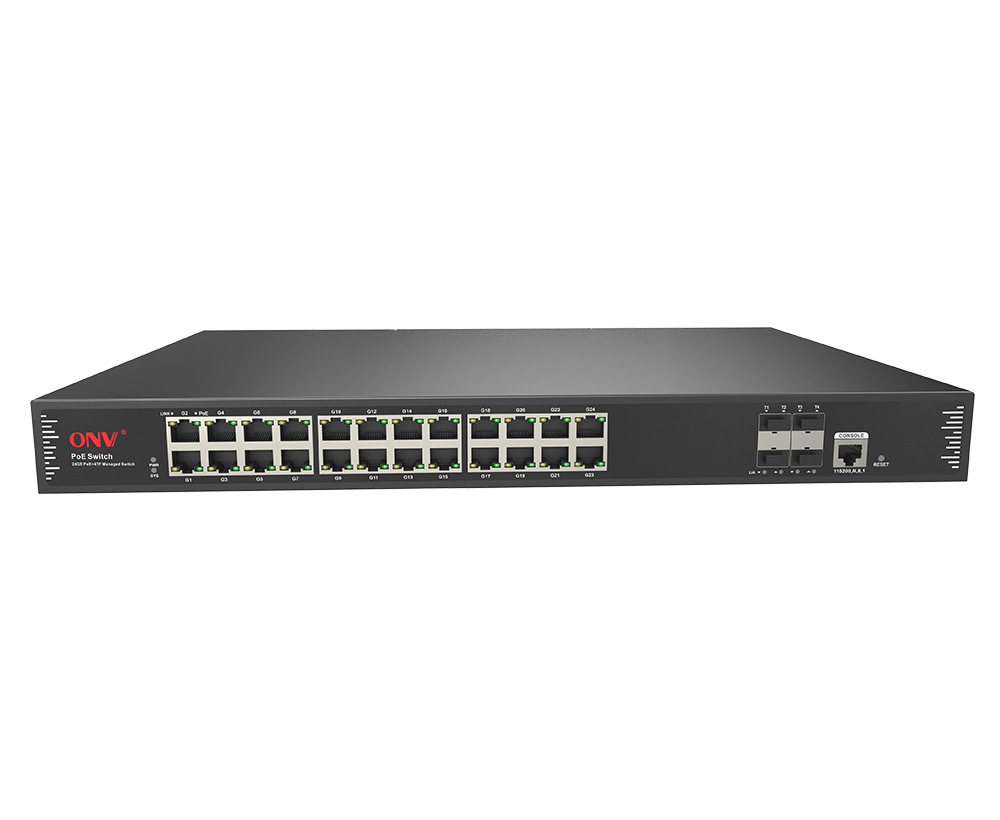
ONV's core routing flagships: 10G SFP+ cores at 880 Gbps, 54-port L3 cores, and the discipline that the centre of the network is specified first and replaced last.
Switching · Core
ONV's core routing flagships: 10G SFP+ cores at 880 Gbps, 54-port L3 cores, and the discipline that the centre of the network is specified first and replaced last.
The core switch is the one box every flow crosses, so it is specified by a different rule than the edge: buy the capacity and port count for the network's fifth year, not its first. The ONV core range tops out with L3 managed core routing models — 24×1/10G SFP+ ports at 880 Gbps switching capacity, and 54-port 10G cores — above a deep bench of 10G uplink L3 models from the aggregation catalogue that serve as cores for mid-size networks.
The featured model is the flagship in full datasheet detail. Note what a core datasheet leads with: capacity, forwarding rate, MAC scale and management depth (SNMP v1/v2/v3 and web management on the featured model) — the numbers that decide whether the centre holds.
Core routing and L3 managed models from the aggregation/core catalogue (official product names).
| Model | Official product name |
|---|---|
| ONV68240-2QFM | 10G 26-port L3 managed core routing switch |
| ONV68240S-2QFM | 10G 26-port L3 managed core routing switch |
| ONV68482-4QFM | 10G 54-port L3 managed core routing switch |
| ONV582424S-6TFM | 10G uplink 54-port L3 managed core switch |
| ONV58480S-6TFM | 10G uplink 54-port L3 managed core switch |
| ONV58024S-4TFM | 10G uplink 28-port L3 managed core switch |
| ONV58280S-4TFM | 10G uplink 28-port L3 managed core switch |
| ONV58008-12TFM | 10G uplink 24-port core routing switch |
| ONV68482-4QFM | 10G 54-port L3 managed core routing switch |
| ONV582424S-6TFM | 10G uplink 54-port L3 managed core switch |
| ONV58480S-6TFM | 10G uplink 54-port L3 managed core switch |
| ONV58024S-4TFM | 10G uplink 28-port L3 managed core switch |
The ONV68240-2QFM: 24 × 1/10G SFP+ fiber ports, 880 Gbps non-blocking capacity, 654.72 Mpps forwarding, a 32K MAC table and full SNMP/web management in a 1U body — a fibre core for campuses and data-bearing buildings.
| Parameter | Datasheet value |
|---|---|
| Fiber ports | 24 × 1/10G SFP+ fiber ports |
| Switching capacity | 880 Gbps (non-blocking) |
| Forwarding rate | 654.72 Mpps @64byte |
| MAC address table | 32K |
| Buffer memory | 32M |
| Management | SNMP v1/v2/v3, browser-based Web management |
| Dimensions | 442.5 × 300 × 44.5 mm |
| Operating temperature | -10°C to +50°C |
Core selection is a capacity and topology exercise: count the aggregation uplinks arriving (each wants a 10G port), add the servers and the NVR/storage block, then double the port count for growth. Redundancy is a design decision above the model choice — dual cores with link aggregation where downtime is unacceptable, a single flagship where it is merely expensive. The datasheet's forwarding rate at 64-byte packets is the honest capacity figure; check it, not just the Gbps headline.
Campus and enterprise cores, hospital and hotel networks, municipal camera backbones and any design whose aggregation layer terminates in one room.
If the cameras aggregate through several access switches into one room, a core — even a mid-range L3 model — keeps that room's switching at wire speed and gives the NVR block a clean, fast home. Very flat designs can terminate on an L3 PoE flagship instead; the L3 PoE page covers that pattern.
Fiber cores dominate at 10G: SFP+ ports take any module — multimode for in-building runs, single-mode between buildings — and avoid copper 10G's distance and heat limits. The featured flagship is all-SFP+ for exactly that reason.
Send your port count, per-port power and uplink requirements — we reply with the exact models, datasheets and a quotation. MOQ and lead time are confirmed per model and order scope in the quotation.
Fiber-port switching at every layer.