Switching · Aggregation
Aggregation switch: where access layers come together
Between the PoE edge and the core sits aggregation: collecting access switches, applying policy and handing off at 10G. ONV's aggregation/core catalogue counts 59 models.
Switching · Aggregation
Between the PoE edge and the core sits aggregation: collecting access switches, applying policy and handing off at 10G. ONV's aggregation/core catalogue counts 59 models.
Aggregation is the least glamorous and most consequential layer: sized too small, it caps every access switch beneath it; sized right, it disappears. The ONV aggregation catalogue spans gigabit Easy managed and L2 models for small networks, a 2.5G series for Wi-Fi 6 estates, and 10G uplink L2+/L3 models up to 54 ports for campus duty.
The PoE flagships live on their own pages; this line is the data layer — the switches that aggregate ONV PoE access switches (and any other access layer) into the core. Several models double as small cores in their own right; the core page covers the routing flagships.
Managed models from the 59-model aggregation/core catalogue (official product names).
| Model | Official product name |
|---|---|
| 2.5G series Ethernet switch | 2.5G series L3 managed Ethernet switch |
| ONV-H53108FMA | Gigabit 10-port Easy managed Ethernet switch |
| ONV56168FM | 10G uplink 16-port L3 managed Ethernet switch |
| ONV68240-2QFM | 10G 26-port L3 managed core routing switch |
| ONV56168FM-4TF | 10G uplink 16-port L3 managed Ethernet switch |
| ONV56012FM | 10G 12-port L3 managed Ethernet switch |
| ONV68240S-2QFM | 10G 26-port L3 managed core routing switch |
| ONV68482-4QFM | 10G 54-port L3 managed core routing switch |
| ONV582424S-6TFM | 10G uplink 54-port L3 managed core switch |
| ONV58480S-6TFM | 10G uplink 54-port L3 managed core switch |
| ONV58024S-4TFM | 10G uplink 28-port L3 managed core switch |
| ONV58280S-4TFM | 10G uplink 28-port L3 managed core switch |
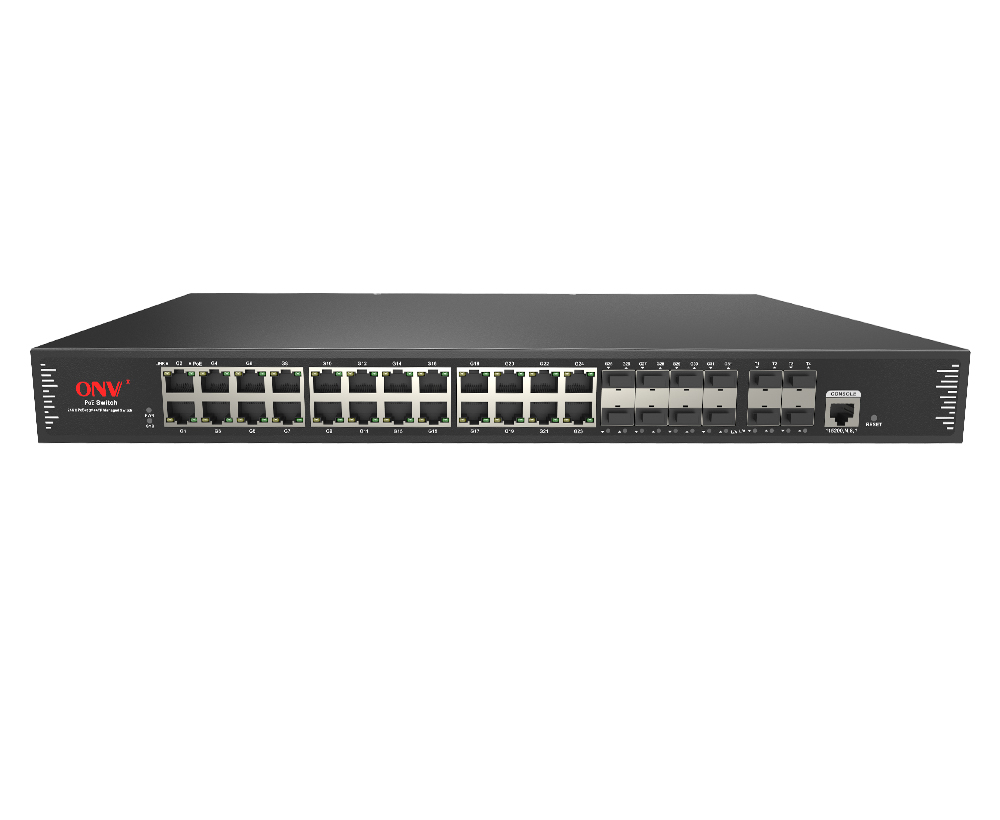
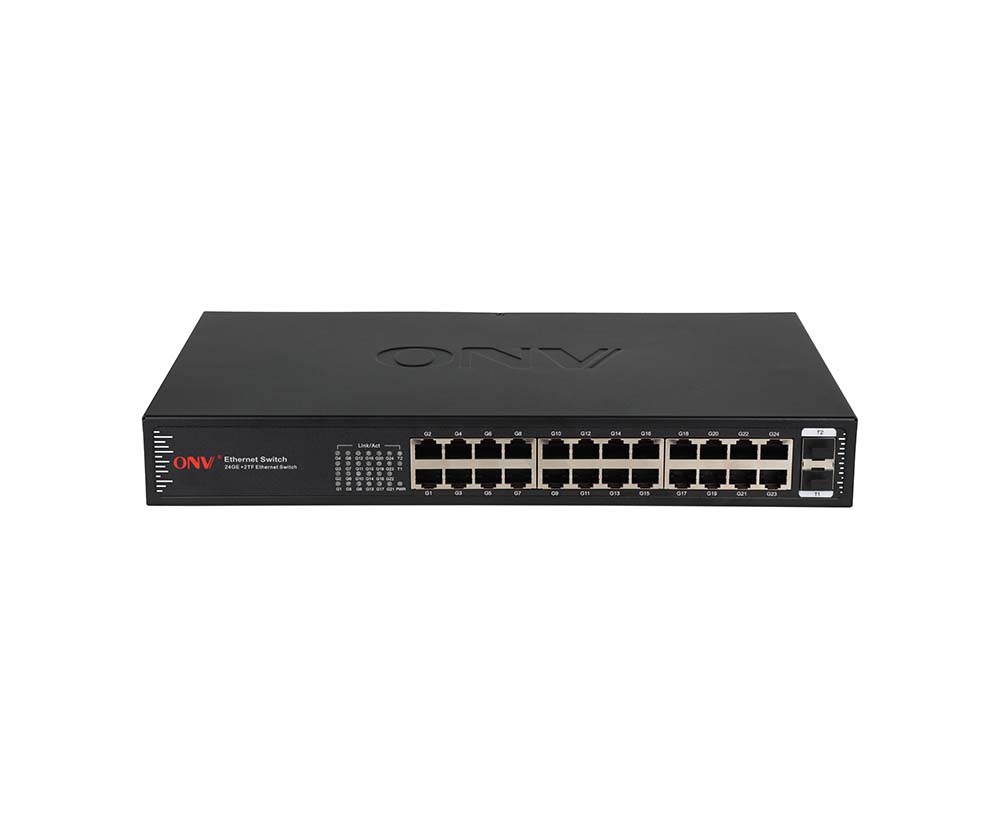
The ONV56024F is the aggregation pattern: 24 gigabit access ports, 10G uplinks (88 Gbps capacity, 65.47 Mpps forwarding) and a modest 30W draw — the quiet middle of a three-layer design.
| Parameter | Datasheet value |
|---|---|
| Access ports | 24 × 10/100/1000Base-T RJ45 |
| Switching capacity | 88 Gbps (non-blocking) |
| Forwarding rate | 65.47 Mpps @64byte |
| MAC address table | 16K |
| Buffer memory | 8.4M |
| Power | 30W, built-in PSU AC100–240V |
| Standards | IEEE 802.3 / 802.3u / 802.3ab / 802.3z / 802.3ae, 2.5G (2500BASE-X) |
Size aggregation by the sum beneath it: total access bitrate at busy hour, times two for headroom, sets the uplink class (gigabit, 2.5G or 10G). Then decide whether aggregation also routes (L3 models) or hands everything to the core. Keep one management tier across the layer — mixed tiers are where configuration drift begins.
Campus and enterprise aggregation, hotel and hospital floors, school districts, and the collection layer above ONV PoE access switches in large surveillance estates.
Role, not size: aggregation collects access switches within a building or zone; the core connects zones and routes the whole network. Small networks merge both into one L3 model — several in this catalogue are specified exactly for that.
Yes — they are one catalogue with consistent management conventions. Mixed-vendor access layers also aggregate cleanly over standard Ethernet and SFP interfaces.
Send your port count, per-port power and uplink requirements — we reply with the exact models, datasheets and a quotation. MOQ and lead time are confirmed per model and order scope in the quotation.
Aggregation with powered ports.