Solution · IP Cameras
PoE switch for IP cameras: the four decisions that matter
Bandwidth, power, distance, recovery. Get those four right and almost any switch in the range works; get one wrong and no switch saves the design.
Solution · IP Cameras
Bandwidth, power, distance, recovery. Get those four right and almost any switch in the range works; get one wrong and no switch saves the design.
IP cameras are undemanding individually — a few megabits, 5–15 watts — and brutal collectively: dozens of them, outdoors, at the ends of long cables, expected to run for years untouched. The PoE switch is where those demands concentrate, and the choice reduces to four decisions. Bandwidth: sum the configured bitrates (H.265 cameras at 4–8 Mbps are typical; 4K at 8–16) and keep every uplink at twice the sum. Power: budget each camera at its night draw, and the switch at 1.25× the total.
Distance: anything past 100 metres needs a deliberate fix — a 250-metre long-distance model, an extender chain, or fiber. Recovery: decide now how a frozen camera comes back — an AI watchdog switch, a managed switch under an operator's hand, or a ladder. ONV's catalogue contains a deliberate answer to each of the four, which is why camera networks are the range's home ground.
The camera-network toolkit: AI watchdog, long-distance and gigabit models (official product names).
| Model | Official product name |
|---|---|
| ONV-H1024PLD | Gigabit uplink 27-port AI PoE switch |
| ONV-H1016PLD | Gigabit uplink 18-port AI PoE switch |
| ONV-H1016PLS-250 | 10M/250 meters transmission gigabit uplink 18-port PoE switch |
| ONV-H1016PLS | 10M/250 meters transmission gigabit uplink 18-port PoE switch |
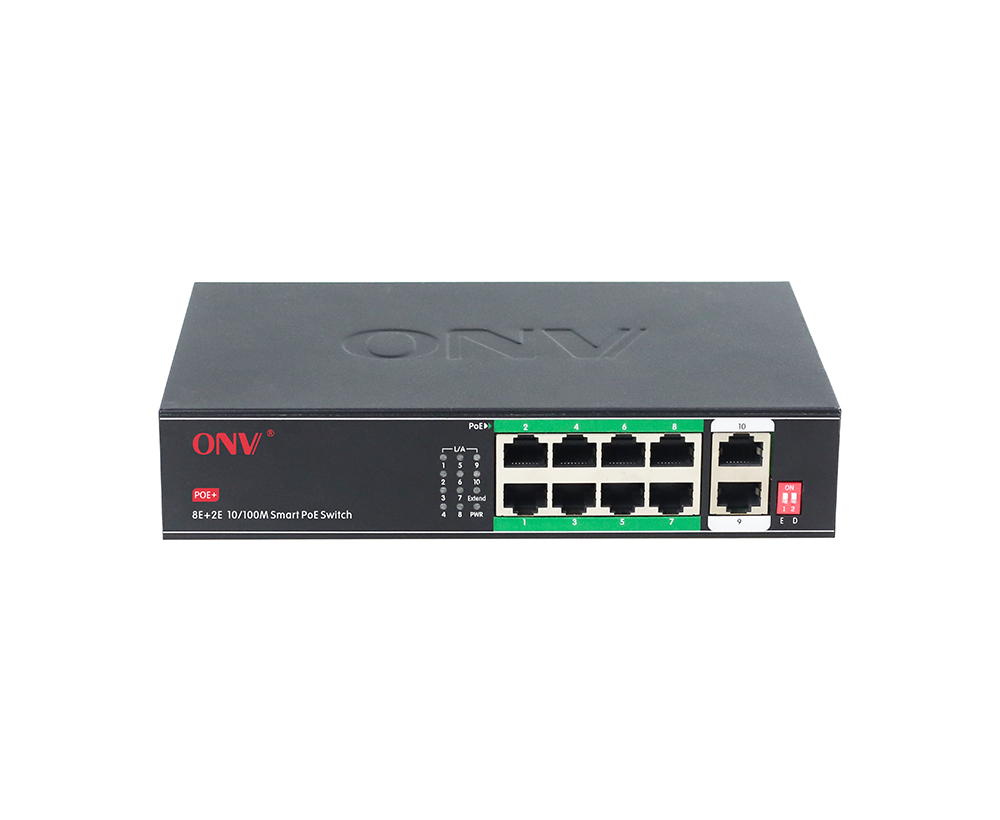
| ONV-POE31108PL | 10M/250 meters transmission 10/100M 10-port PoE switch |
| ONV-POE31064PL | 10M/250 meters transmission 10/100M 6-port PoE switch |
| ONV-POE33020PFM | Gigabit 20-port L2+ managed PoE switch |
| ONV-POE33028PFM | Gigabit 28-port L2+ managed PoE switch |
| ONV-POE33108PFG | Gigabit 10-port PoE switch |
| ONV-H53054PFDM | Gigabit 6-port Easy managed PoE switch |
Recovery, built in: the ONV-H1024PLD AI PoE switch watches 24 camera ports and restarts a frozen camera's power automatically — the fourth decision, answered in hardware.
| Parameter | Datasheet value |
|---|---|
| PoE ports | 24 × IEEE 802.3 af/at PoE ports |
| Max power per port | 30W |
| Switching capacity | 14.8 Gbps (non-blocking) |
| MAC address table | 16K |
| Buffer memory | 4M |
| AI function | PoE watchdog: automatically restarts a powered device whose link has failed |
Work the four decisions in order and the model picks itself. A worked example: 18 fixed cameras (10W night draw, 6 Mbps each), longest run 165m, no on-site IT. Power: 180W × 1.25 → a 250W-class budget. Bandwidth: 108 Mbps summed → gigabit uplinks. Distance: the 165m run → long-distance model or an extender. Recovery: no IT → AI watchdog. The answer is an 18-port-class AI/long-distance gigabit switch — three of which sit in the table above.
Any IP camera estate: commercial premises, campuses, logistics, public space. The CCTV solution page covers the wider system, including NVR-side switching.
Plan 12–15W for a fixed IR camera, 20–25W for a varifocal or multi-sensor unit, and 30W+ for PTZ with heating — then verify against the camera's datasheet. The switch budget is the sum, times 1.25.
Follow the cabling: cameras cluster around cabinets, so switches should too. Several right-sized switches near camera clusters beat one giant switch with long cable runs — and keep any single failure small.
Send your port count, per-port power and uplink requirements — we reply with the exact models, datasheets and a quotation. MOQ and lead time are confirmed per model and order scope in the quotation.
The distance fix.
Distance physics, plainly.