Guide · Fundamentals
A PoE switch is an Ethernet switch that also delivers DC power over the same cable as the data — so a camera, phone or access point needs one cable, not two. Everything else is detail; this guide covers the detail that matters.

Power over Ethernet (PoE) puts electrical power onto the same twisted-pair cable that carries data, using spare or shared pairs under the IEEE 802.3 standards. A PoE switch is simply the switch whose ports can supply that power: plug in a PoE camera and it receives data and electricity over one run; plug in a non-PoE device and the port behaves like any other (power is only delivered after a standards handshake, so nothing is harmed). The concept eliminates the power adapter at every device — which is why surveillance, wireless and telephony estates are built on it.
Three standards numbers run the whole subject. 802.3af (PoE) delivers up to 15.4W per port; 802.3at (PoE+) up to 30W; 802.3bt (PoE++) up to 60W (Type 3) or 90W (Type 4). Most cameras live comfortably in af/at territory; motorised PTZ domes and high-power radios reach into bt. Two more distinctions decide real purchases: the total PoE budget (the sum a switch can deliver across all ports — the binding constraint, always) and the management tier (unmanaged plug-and-play, or managed with VLANs, monitoring and remote per-port power control). Distance completes the picture: standard PoE runs 100 metres on copper, with long-distance models, extenders and fiber covering everything beyond. The range pages of this site are organised along exactly these axes — port count, power, management, distance.
Entry points: smart PoE models from the catalogue (official product names).
| Model | Official product name |
|---|---|
| ONV-H1064PLD | 10/100M 6-port smart PoE switch |
| ONV-POE31004PLD | 10/100M 5-port smart PoE Switch |
| ONV-POE31008PLD | 10/100M 9-port smart PoE switch |
| ONV-H1054PS | 10/100M 5-port smart PoE switch |
| ONV-H1108PGS | Gigabit uplink 10-port smart PoE switch |
| ONV-H3054PS | Gigabit 5-port smart PoE switch |
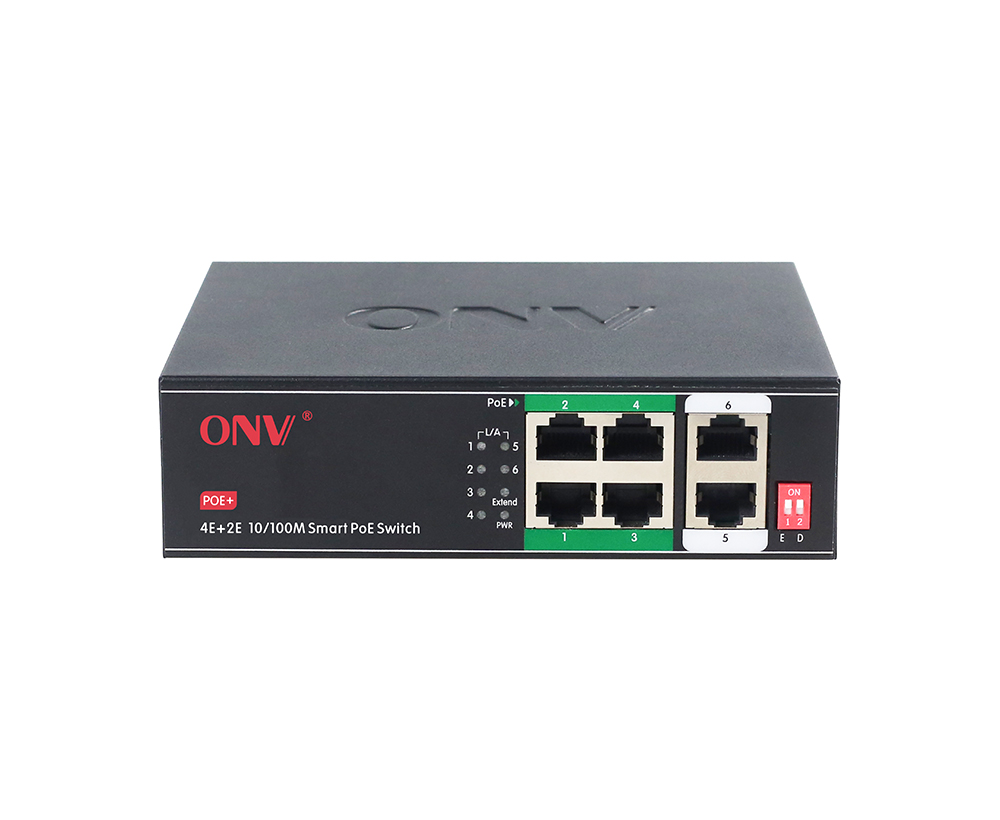
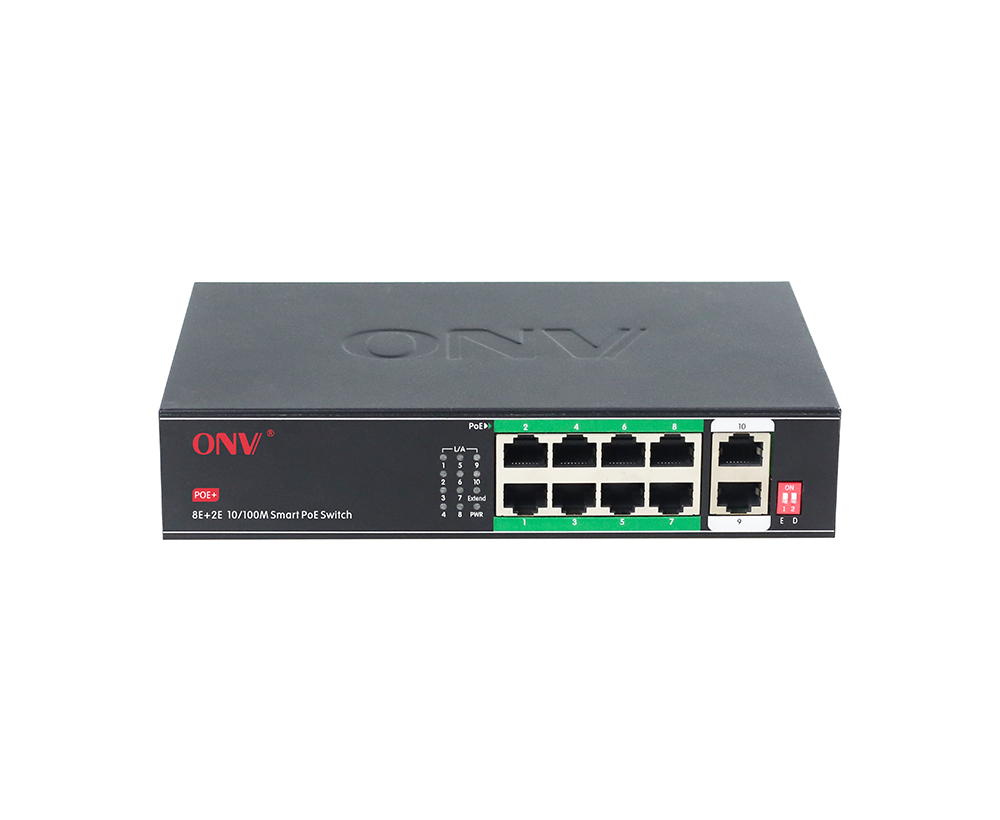
A PoE switch in miniature: the ONV-H1064PLD's datasheet shows the anatomy — PoE ports with a per-port maximum (30W, af/at), a total power figure (65W), data specifications, and the surveillance extras (250m mode, watchdog) that this class adds.
| Parameter | Datasheet value |
|---|---|
| PoE ports | Port 1–4, IEEE 802.3 af/at |
| Uplink ports | 2 × 10/100Base-TX RJ45 |
| Max power per port | 30W |
| Total PoE power | 65W (built-in PSU, AC100–240V) |
| Switching capacity | 1.6 Gbps (non-blocking) |
| Forwarding rate | 0.89 Mpps @64byte |
| Long-distance mode | 10M / 250 meters transmission (function switch E) |
| PoE watchdog | Function switch D: auto-restarts a failed powered device |
| Dimensions | 142.5 × 115 × 40 mm |
| Operating temperature | -20°C to +55°C |
| Certification (datasheet) | CE mark, CE/LVD EN62368-1, FCC Part 15 Class B, RoHS |
To choose one: count devices, sum their wattage (at night draw for cameras), add 25%, and pick a switch whose total budget clears the sum and whose port count leaves spares. Choose gigabit if anything on the segment outruns 100 Mbps or if uplinks aggregate. Choose managed if the network will be segmented, monitored or remotely maintained. The buying guide in the blog turns this into a checklist, and the troubleshooting guide covers what to do when a built system misbehaves.
If you are speccing a real system, the fastest route is the device list: send camera/AP models and counts and our team returns the switch shortlist with budgets already summed.
The port will not energise a non-PoE device (the handshake prevents it) — use a PoE splitter at the device end to separate data and DC power.
No — power and data coexist at full line rate. Only deliberate long-distance modes trade speed (10M) for reach (250m), on the ports where that trade is chosen.
Send your port count, per-port power and uplink requirements — we reply with the exact models, datasheets and a quotation. MOQ and lead time are confirmed per model and order scope in the quotation.
The other fundamental choice.
The handshake and delivery, step by step.