Fiber Line · Single-Mode
Multimode is a building technology; single-mode is a territory technology. ONV's single-mode converters carry Ethernet across campuses, roads and farmland — 40 km at 1310nm, 120 km at 1550nm.

Single-mode fiber has a core so fine (and a laser so disciplined) that the practical limit stops being the fiber and becomes the optics: in the ONV converter datasheets, single-mode reach is stated as 0–40 km at 1310nm and 0–120 km at 1550nm. That makes the single-mode converter the tool for links between buildings, along perimeters, across industrial sites and out to remote gates and cameras.
Two strand strategies sit in the catalogue: dual-fiber models (a strand each way — simple, standard) and single-fiber WDM models (both directions on one strand at two wavelengths — for leased fiber or exhausted ducts, bought as matched A/B pairs). Speeds run 10/100M for sensor-class links and gigabit for everything else.
Single-mode models from the media converter catalogue (official product names).
| Model | Official product name |
|---|---|
| ONV1110-SLX-F | Gigabit 2-port single-mode dual fiber media converter |
| ONV0110-SCX-S2 | 10/100M 3-port single-mode dual fiber media converter |
| ONV0110-SCX-S4 | 10/100M 5-port single-mode dual fiber media converter |
| ONV1110-SLX-S4 | Gigabit 5-port single-mode dual fiber media converter |
| ONV1110S-SCX-O-A3 | Gigabit 2-port single-mode single fiber media converter |
| ONV1110-SCX-K | Gigabit 2-port single-mode dual fiber media converter |
| ONV0110-SCX-O | 10/100M 2-port single-mode dual fiber media converter |
| ONV1110-SCX-O | Gigabit 2-port single-mode dual fiber media converter |
| ONV1110-SCX-S2 | Gigabit 3-port single-mode dual fiber media converter |
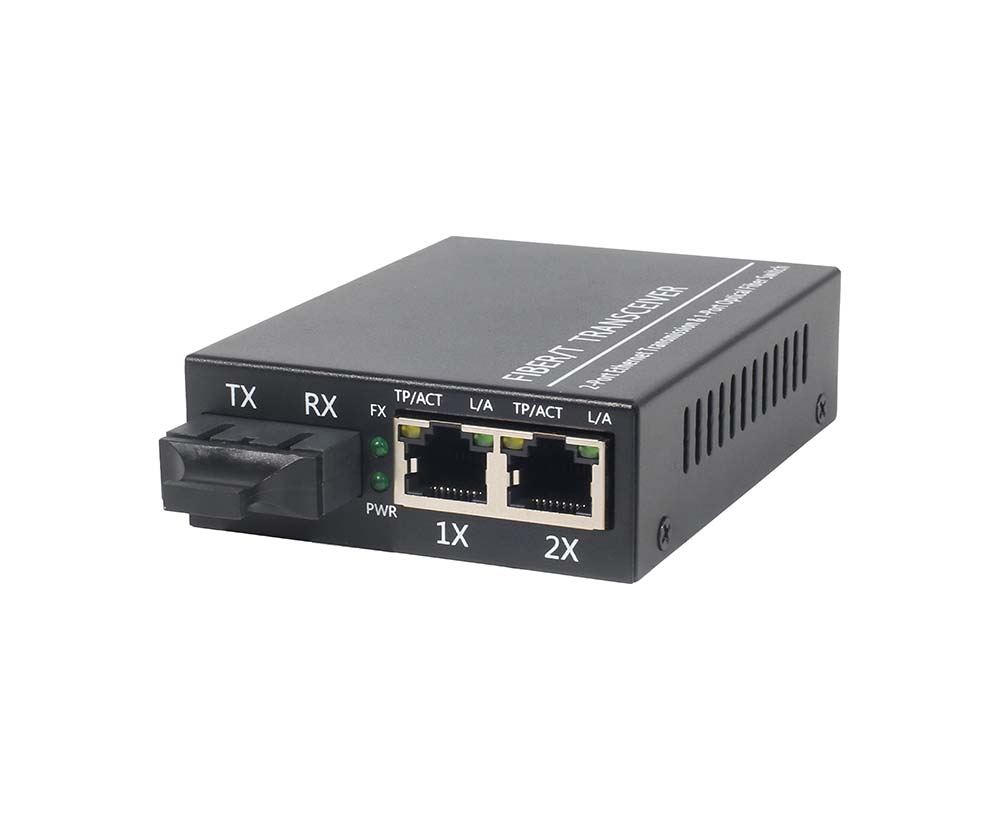
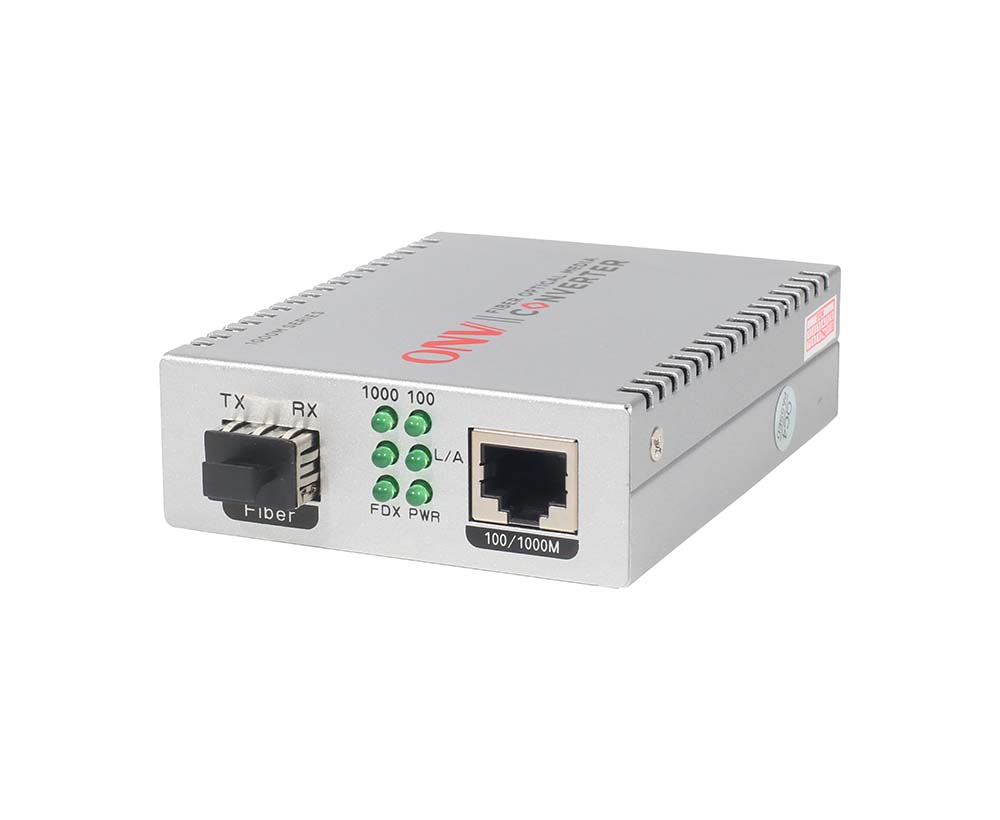
The featured gigabit converter accepts single-mode dual-fiber and single-mode single-fiber SFP options, with the datasheet reach table quoted on the media converter page — one hardware unit, reach set by the module fitted.
| Parameter | Datasheet value |
|---|---|
| Copper port | 1 × 10/100/1000Base-T RJ45 |
| Fiber port | 1 × 1.25G SFP (multi-mode dual fiber / single-mode dual fiber / single-mode single fiber options) |
| Switching capacity | 2.0 Gbps (non-blocking) |
| Forwarding rate | 3.0 Mpps |
| MAC address table | 2K |
| Buffer memory | 1M |
| Power | 3.5W / 5V DC |
| Optical reach | Multimode 0–550m; single-mode 1310nm 0–40km, 1550nm 0–120km |
| Operating temperature | -20°C to +55°C |
| Mode | Unmanaged, plug and play |
Decide strands first: if you are pulling new fiber, pull dual-fiber single-mode and never think about it again; if the duct or the lease gives you one strand, WDM single-fiber pairs are the answer (order them as the matched A/B pair — the two ends are different). Then wavelength by distance: 1310nm optics cover most sites to 40 km; 1550nm is for genuinely long hauls. Leave loss margin — splices and connectors eat budget that the headline reach assumes is clean.
Inter-building and campus links, road and perimeter runs, remote gates and cameras, utility and pipeline telemetry, farm and port sites.
Single-mode, unambiguously: multimode's gigabit ceiling is 550m. At 2 km the choice is only between 1310nm optics and a longer-reach set.
No — the two ends must be a matched pair of the same strategy and wavelength plan. WDM pairs are sold as A and B units for this reason.
Send your port count, per-port power and uplink requirements — we reply with the exact models, datasheets and a quotation. MOQ and lead time are confirmed per model and order scope in the quotation.
The full comparison.
Fiber ports without converters.