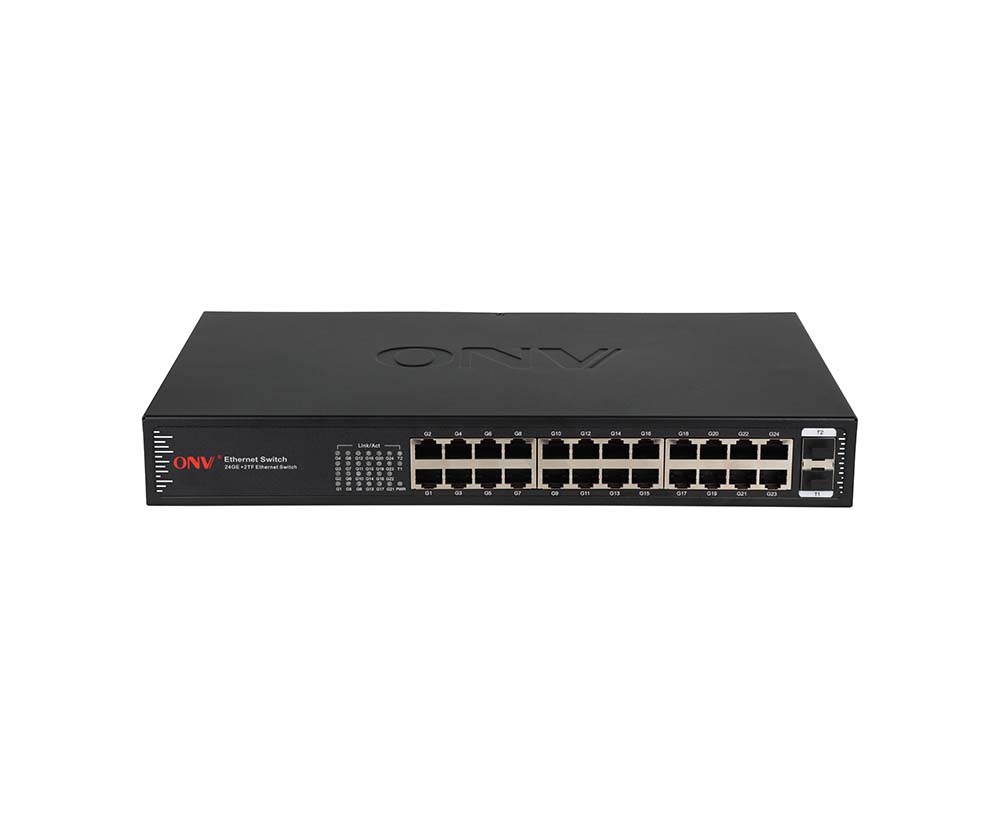
PoE Switch · 10G Uplink
When several gigabit access switches — or one 48-port PoE switch full of 4K cameras — aggregate upward, a gigabit uplink saturates. ONV's 10G uplink PoE models keep the access layer PoE and the backbone at 10G.

The 10G PoE class is defined by its uplinks: PoE access ports in gigabit (and on some series 2.5G), with 10G SFP+ uplinks into the core. In the ONV catalogue these are the L2+ and L3 managed flagships — 18 to 52 ports, switching capacities from 176 to 216 Gbps, and fiber reach by module from 550 metres on multimode to 120 km on single-mode (1550nm), per datasheet.
A second series serves the middle ground: 2.5G uplink and 2.5G access models for Wi-Fi 6 access points whose radios outrun a gigabit port. Both series appear in the table; the buying guide below separates the two use cases.
10G uplink and 2.5G models from the PoE switch catalogue (official product names).
| Model | Official product name |
|---|---|
| ONV-POE56024PF | 10G uplink 26-port PoE switch |
| ONV-POE56016PF | 10G uplink 18-port PoE switch |
| ONV-POE56036PFM | 10G uplink 36-port L2+ managed PoE switch |
| ONV-POE56052PFM | 10G uplink 52-port L2+ managed PoE switch |
| ONV-POE56028PFM | 10G uplink 28-port L2+ managed PoE switch |
| ONV-POE36048PFM | 10G uplink 52-port L2+ managed PoE switch |
| ONV-POE36036PFM | 10G uplink 36-port L2+ managed PoE switch |
| ONV-POE36028PFM | 10G uplink 28-port L2+ managed PoE switch |
| ONV-POE37024PF | 2.5G uplink 26-port PoE switch |
| ONV-POE37016PF | 2.5G uplink 18-port PoE switch |
| ONV-POE57008PFB | 2.5G 9-port PoE switch |
| ONV-POE57064PFB | 2.5G 6-port PoE switch |
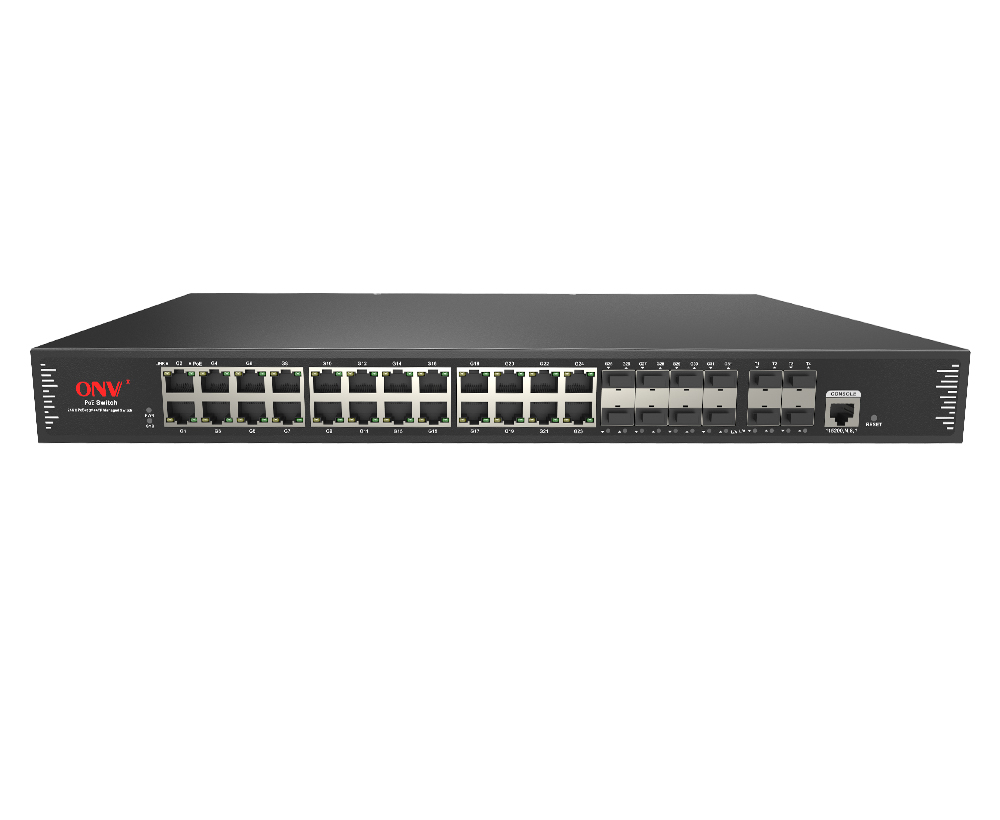
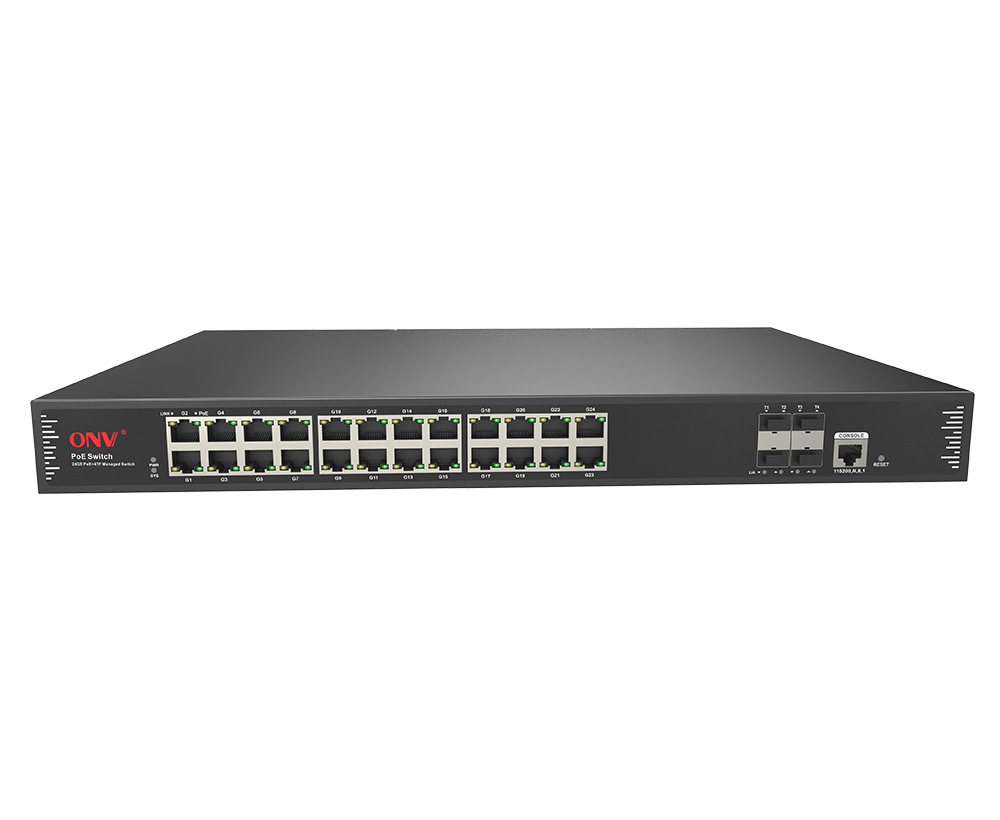
The ONV-POE38028PFM pairs 24 PoE ports with 10G uplinks and L3 management: 176 Gbps switching capacity, 32K MAC table and 400W/600W budget versions — the aggregation pattern in one rack unit.
| Parameter | Datasheet value |
|---|---|
| PoE ports | Port 1–24, IEEE 802.3 af/at |
| Max power per port | 30W |
| Total PoE power | 400W / 600W versions (AC100–240V) |
| Switching capacity | 176 Gbps (non-blocking) |
| MAC address table | 32K |
| Buffer memory | 32M |
| Console | 1 × RS232 console port |
| Optical reach (via SFP) | Multimode 0–500m; single-mode 1310nm 0–40km, 1550nm 0–120km |
Do the uplink arithmetic before choosing: sum the realistic bitrate of everything below the switch (cameras at their configured bitrate, APs at their busy-hour load), and keep the uplink at least twice that figure. One 24-port gigabit access switch fully loaded justifies a 10G uplink on headroom alone; add a second switch beneath it and 10G becomes mandatory. For single high-speed devices — a Wi-Fi 6 AP or a workstation — a 2.5G access port is the proportionate answer.
Campus and hospital aggregation, 4K camera backhaul, hotel and dormitory floors, and any design stacking multiple access switches under one core.
Count them: twenty-four 8 Mbps camera streams are under 200 Mbps — a gigabit uplink is fine. Ten 4K cameras at 32 Mbps plus growth is another story. Size by summed bitrate, not port speed.
On the featured models they are SFP-based fiber uplinks — the datasheets list 10GBase-LR/SR support, with reach set by the module fitted: multimode to 550m, single-mode to 40 km (1310nm) or 120 km (1550nm).
Send your port count, per-port power and uplink requirements — we reply with the exact models, datasheets and a quotation. MOQ and lead time are confirmed per model and order scope in the quotation.
The middle layer in full.
Fiber-port switching.