PoE Switch · By Port Count
The 24-PoE-port class is building-level aggregation: one rack unit powering a floor's cameras and access points, with gigabit or 10G uplinks into the core and — in the L3 models — routing on the same box.

The 24-PoE-port class is building-level aggregation: one rack unit powering a floor's cameras and access points, with gigabit or 10G uplinks into the core and — in the L3 models — routing on the same box.
This is where management stops being optional for most buyers. VLANs separate camera, office and guest traffic; SNMP and web management expose per-port PoE status; and SFP uplinks carry the aggregate feed over fiber to the core. The catalogue's class spans unmanaged gigabit models for simple segments up to the L3 flagship featured here.
Models in the 24-PoE-port class from the official catalogue (official product names).
| Model | Official product name |
|---|---|
| ONV-POE33026PFM | Gigabit 26-port L2+ managed PoE switch |
| ONV-POE33020PFM | Gigabit 20-port L2+ managed PoE switch |
| ONV-POE33028PFM | Gigabit 28-port L2+ managed PoE switch |
| ONV-POE37024PF | 2.5G uplink 26-port PoE switch |
| ONV-POE56024PF | 10G uplink 26-port PoE switch |
| ONV-H1024PFD-2BT | Gigabit uplink 27-port PoE switch |
| ONV-H2024PFG-YS | Gigabit uplink 27-port non-standard PoE switch |
| ONV-POE53028PFCMS | Gigabit 28-port Easy managed PoE switch |
| ONV-POE53020PFCM | Gigabit 20-port Easy managed PoE switch |
| ONV-POE53028PFCM | Gigabit 28-port Easy managed PoE switch |
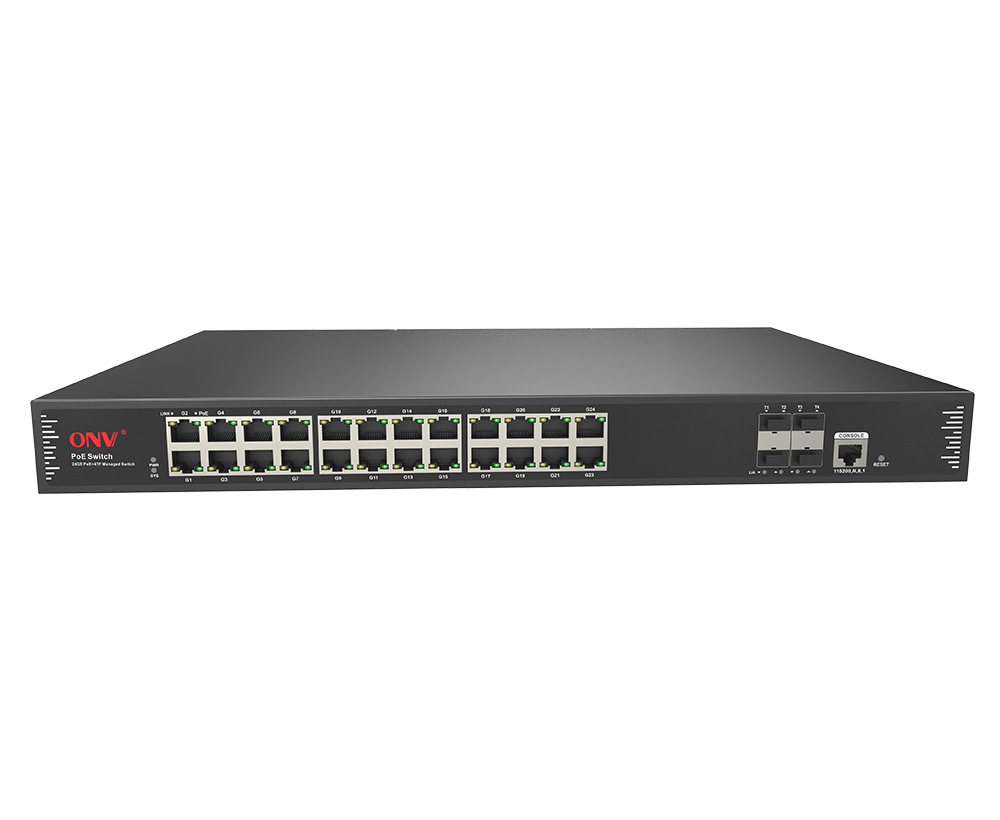
The ONV-POE38028PFM anchors this class: 24 PoE ports, 400W/600W budget versions, 10G uplinks and L3 management with a 176 Gbps switching capacity.
| Parameter | Datasheet value |
|---|---|
| PoE ports | Port 1–24, IEEE 802.3 af/at |
| Max power per port | 30W |
| Total PoE power | 400W / 600W versions (AC100–240V) |
| Switching capacity | 176 Gbps (non-blocking) |
| MAC address table | 32K |
| Buffer memory | 32M |
| Console | 1 × RS232 console port |
| Optical reach (via SFP) | Multimode 0–500m; single-mode 1310nm 0–40km, 1550nm 0–120km |
The 24-PoE-port class is sized by a simple rule: count the powered devices on the segment, then leave at least two spare ports. Power matters as much as ports — add up the draw of every camera, access point or phone and compare it with the total PoE budget in the datasheet, not the headline per-port figure. Where the segment also carries uplinks to another switch or an NVR, prefer the models with dedicated gigabit or SFP uplinks so camera traffic never competes with the uplink.
Typical deployments for this class are detailed in the CCTV and IP camera solution pages; the same hardware also powers wireless access points, IP phones and access-control readers on the same segments.
When the switch aggregates several gigabit access switches or carries many high-bitrate cameras to a central NVR. A single 24-port access switch usually saturates neither, but the moment two or three are stacked under one uplink, 10G stops being a luxury.
Often yes: 24 ports cover a small building's cameras, APs and phones, and the 400W/600W budgets of the managed models cover mixed loads. Segment the traffic with VLANs and keep the NVR on a dedicated port or a core switch.
Send your port count, per-port power and uplink requirements — we reply with the exact models, datasheets and a quotation. MOQ and lead time are confirmed per model and order scope in the quotation.
Which control level your project needs.
How to size watts per port and per switch.