PoE Switch · 802.3at
PoE+ switch: 30 watts on every port
IEEE 802.3at (PoE+) doubles the per-port power of the original standard — and it is the baseline of the ONV gigabit range, from 4-port desktop units to 52-port managed cores.
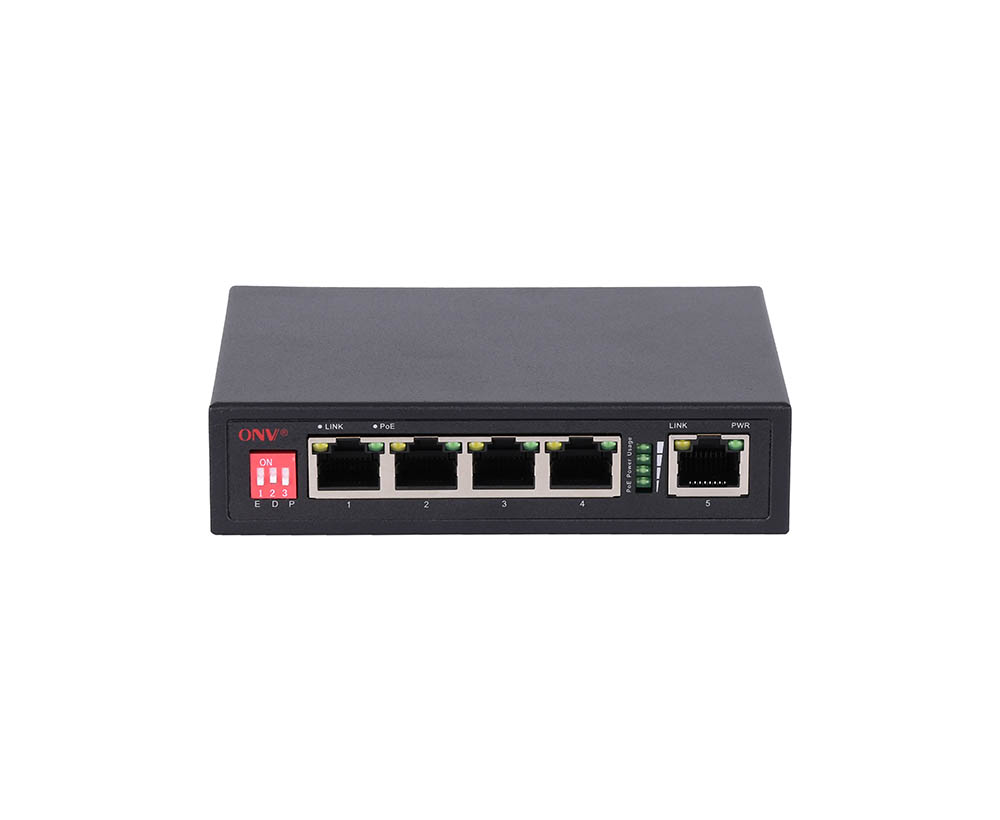
PoE Switch · 802.3at
IEEE 802.3at (PoE+) doubles the per-port power of the original standard — and it is the baseline of the ONV gigabit range, from 4-port desktop units to 52-port managed cores.
802.3af, the original PoE standard, guarantees 15.4W at the switch port (12.95W at the device). That was enough for fixed cameras and phones; it is not enough for a PTZ dome with motors and heaters, a Wi-Fi 6 access point at full radio load, or an IR camera on a cold night. 802.3at — PoE+ — raises the guarantee to 30W per port (25.5W at the device), which is why it has become the default for new installations.
In the ONV catalogue, PoE+ is not a sub-line: it is the standard capability of the gigabit PoE range and the industrial PoE line, with datasheets stating 'Max Power Per Port: 30W, IEEE 802.3 af/at' across the models. The buying decision is therefore rarely 'PoE or PoE+' — it is which port count, budget and management tier carries the 30W ports your devices need, and whether any device exceeds 30W and pushes you to the bt line.
Gigabit PoE+ models from the standard and industrial catalogues (official product names).
| Model | Official product name |
|---|---|
| ONV-H3064P | Gigabit 6-port PoE switch |
| ONV-H3108P | Gigabit 10-port PoE switch |
| ONV-H3064PS | Gigabit 6-port PoE switch |
| ONV-H3108PS | Gigabit 10-port PoE switch |
| ONV-POE33020PFM | Gigabit 20-port L2+ managed PoE switch |
| ONV-POE33028PFM | Gigabit 28-port L2+ managed PoE switch |
| ONV-POE33108PFG | Gigabit 10-port PoE switch |
| ONV-H53054PFDM | Gigabit 6-port Easy managed PoE switch |
| ONV-IPS33018PFM | Gigabit 18-port L2+ managed industrial PoE switch |
| ONV-IPS33026PFM | Gigabit 26-port L2+ managed industrial PoE switch |
| ONV-IPS33020PFM | Gigabit 20-port L2+ managed industrial PoE switch |
| ONV-IPS33024PM-8F | Gigabit 24-port L2+ managed industrial PoE switch |
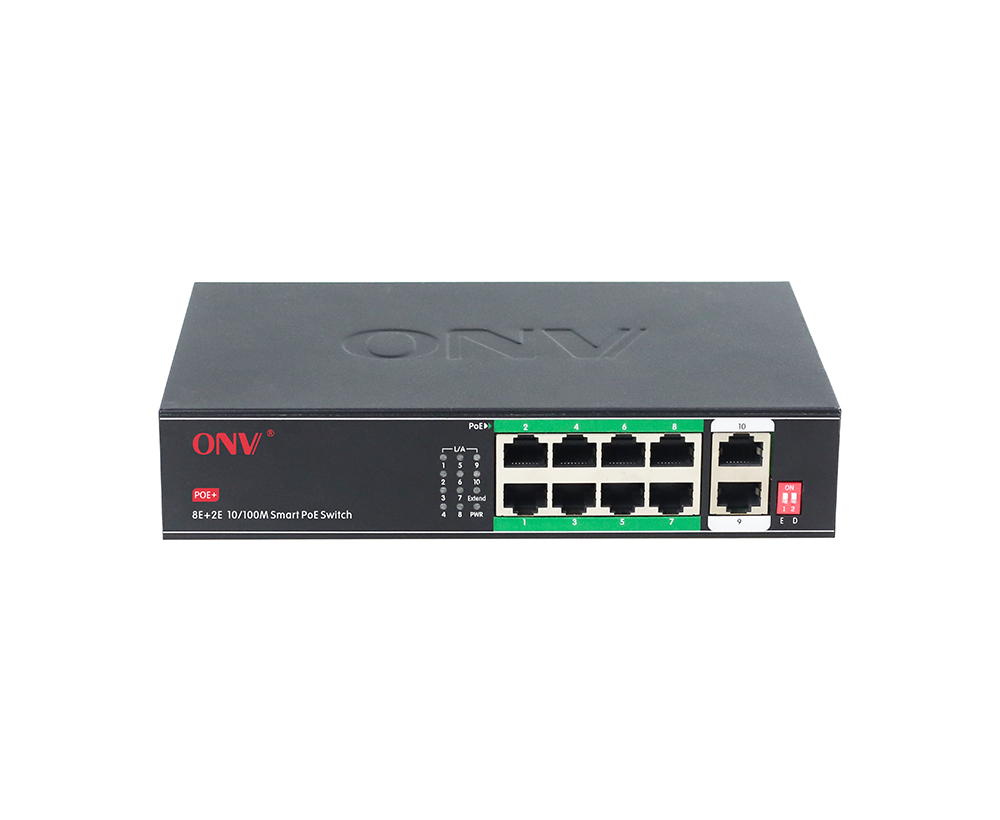
PoE+ is stated explicitly in the ONV-H1016PLS datasheet — 'Max Power Per Port: 30W, PoE+' — alongside a 160W/250W budget choice and 250-metre transmission. It is the class pattern: 30W ports, a budget sized for real mixed loads, and surveillance features on top.
| Parameter | Datasheet value |
|---|---|
| PoE ports | Port 1–16, PoE+ (IEEE 802.3 af/at) |
| Max power per port | 30W, PoE+ |
| Total PoE power | 160W / 250W versions (AC100–240V) |
| Switching capacity | 14.8 Gbps (non-blocking) |
| MAC address table | 16K |
| Buffer memory | 4M |
| Long-distance mode | 10M / 250 meters transmission on PoE ports |
Size a PoE+ switch by total budget, not per-port power. List every device with its real draw (nameplate or datasheet), sum it, multiply by 1.25 for headroom, and compare with the total PoE budget printed in the switch datasheet. A 16-port switch with 30W ports but a 150W budget cannot run sixteen 30W devices — the budget is the binding number. The power budget guide in the blog works through the arithmetic with examples.
PTZ and speed-dome cameras, Wi-Fi 6/6E access points, IP video phones, access controllers with locks, and any mixed camera + wireless segment.
No. PoE+ is backward compatible: the switch detects the device's class and delivers only what the standard negotiation allows. af devices run normally on at ports.
Yes, with margin: 802.3at delivers 25.5W at the powered device after cable losses. If the device's requirement is quoted at the port (30W), it is exactly at the class limit — for anything above, use the bt models.
Send your port count, per-port power and uplink requirements — we reply with the exact models, datasheets and a quotation. MOQ and lead time are confirmed per model and order scope in the quotation.
Up to 90W per port.
The standards compared.
Sizing the watts correctly.